Empowering Future-Ready AI Architects & Researchers
Established in 2020-21 with an intake of 60, expanded to 90 in 2024-25, and now offering an undergraduate B.E. program with an intake of 150 students for 2026-27. Our curriculum balances rigorous mathematics with cutting-edge experiential learning in GenAI, Prompt Engineering, and Deep Neural Systems.

About the Department
Official academic dossier & departmental overview for academic year 2026-27
Academic Profile & Evolution
Department of Artificial Intelligence and Machine Learning was established in the academic year 2020-21 with an intake of 60 and is approved by AICTE and VTU. The intake has been increased to 90 in the academic year 2024-25. The department offers an undergraduate B.E program with an intake of 150 students for the academic year 2026-27.
The department has well qualified teaching faculty with research, teaching and industrial experience. The department has state-of-the-art laboratories. The program is designed by VTU and electives are offered to provide hands-on and advanced knowledge in the field of Artificial Intelligence and Machine Learning.
The Department offers all aspects of experiential learning as prescribed by Visvesvaraya Technological University, Belagavi. The course curriculum is in line with the latest technology needed to the industry in both Computer Science and Engineering and Artificial Intelligence.
Key Highlights
- AICTE Approved & VTU Affiliated undergraduate B.E. degree.
- 3 Advanced Laboratories covering AI, ML, NLP, UI/UX, MongoDB, Git, and Analytics.
- Renowned Research Faculty: Led by Dr. Shaila K (29 yrs exp, 150+ papers, 2 published books).
- Experiential Learning: Deep integration of GenAI, Prompt Engineering, and Quantum computing.
- Remedial & MOOCs Support: Financial assistance for NPTEL/Coursera certifications.
Vision & Mission
Guiding principles shaping future artificial intelligence professionals
Department Vision
"To achieve quality education in the field of Artificial Intelligence and Machine Learning focusing on fundamentals, innovation and research."
Department Mission
- To provide students with strong fundamentals in the field of Artificial Intelligence and Machine Learning.
- To impart professional ethics, leadership qualities and a determination to succeed in life.
- To impart rigorous training to enhance the knowledge through interdisciplinary concepts and technologies related to Artificial Intelligence and Machine Learning.
- To encourage innovation and enhance research in emerging areas by collaborating with industries and institutions.
Department Goals & Good Practices
Strategic roadmap, academic nurturing, and student-first pedagogical standards
Short-Term Goals
- Improve academic performance with Next-Gen Technologies, Generative AI, Prompt Engineering and Quantum Engineering.
- Organize high-impact programs: Seminars, workshops, Faculty Development Programs (FDP), and Student Development Programs (SDP).
- Publish research papers in peer-reviewed national and international journals and conferences.
Long-Term Goals
- Establish dedicated Research Centre: Create a recognized hub for doctoral research, funded grants, and patent filing in Machine Intelligence.
- Industry Collaboration: Foster strategic tie-ups and MoUs with tech enterprises for live capstones, co-designed electives, and consultancy.
Good Practices Implemented in the Department
Holistic Motivation
Motivates students with curricular and extra-curricular activities to nurture well-rounded character.
Remedial Coaching
Conducts dedicated remedial coaching classes for slow learners to ensure zero student drop-off.
Financial Aid for MOOCs
Students and faculties are encouraged with financial assistance to take up specialized MOOCs courses.
Value-Added Programs
Conducts regular value-added programs beyond the syllabus to bridge academia and industry demands.
Practical Skill Building
Improving technical skills by arranging hands-on workshops, seminars, internships, and educational industrial visits.
Laboratory Facilities (3 State-of-the-Art Labs)
Cutting-edge computational infrastructure supporting full-stack artificial intelligence and machine learning workflows
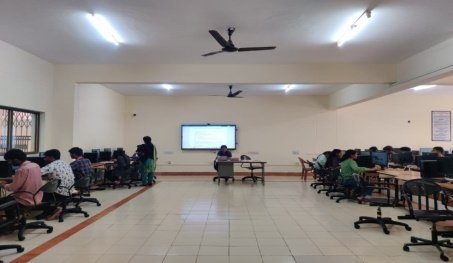
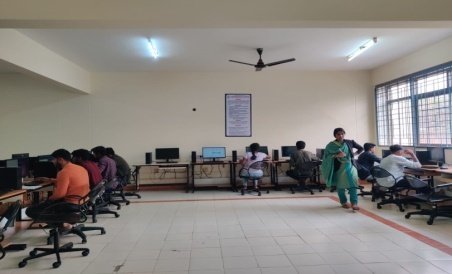
Curricular Modular Domains Handled Across Laboratories
1. Artificial Intelligence Lab
2. Machine Learning Lab
3. Analysis & Design of Algorithms Lab
4. MongoDB Lab
5. UI/UX Lab
6. Natural Language Processing Lab
7. Data Base Management System Lab
8. Data Structure Lab
9. Programming with Git Lab
10. Data Analytics Lab
11. Data Visualization Lab
12. Operating System Lab
13. Networks Lab
Head of the Department
Academic profile, scholarly distinctions, and research portfolio of Dr. Shaila K

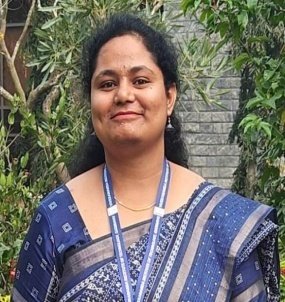
Dr. Shaila K is presently the Head of the Department of Artificial Intelligence and Machine Learning. She has over 29 years of teaching experience and 18 years of research experience. She was Professor and Head of the Department of Electronics and Communication Engineering, Vivekananda Institute of Technology from May 2012 till June 2019 and Placement Officer from 2021 till 2023.
She has obtained multidisciplinary degree with Ph.D in Computer Science and Engineering, University Visvesvaraya College of Engineering from Bangalore University, M.E in Electronics and Communication from University Visvesvaraya College of Engineering, Bangalore University and B.E in Electronics from PES Institute of Technology, Bangalore University, Bangalore.
She has authored 2 reputed textbooks: "Digital Circuits and Systems" published by Tata McGraw Hill, New Delhi and "Secure Data Communication Techniques" by LAP LAMBERT publishers, Germany. She has guided five Ph.D scholars and one scholar is pursuing Ph.D in VTU. She has 80 papers in refereed International Journals and 70 papers in International Conferences to her credit.
She has received the Best Teacher and Best Researcher Award, Best Project award, and received research grants from AICTE. She has obtained Star Performer recognition from NPTEL. Her name appears in the prestigious Marquis Who's Who in the World Science and Engineering. She is a Senior Member of IEEE (S-IEEE), Life Member of ISTE, iMAPs, Member of ACM, and IEANG. Her research interests encompass Wireless Sensor Networks, Adhoc Networks, Internet of Things, Cyber Security, Artificial Intelligence, Deep Learning, Natural Language Processing, and Image Processing.
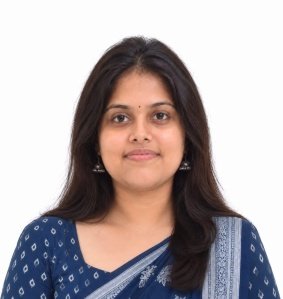
Teaching Faculty Directory
Dedicated educators, researchers, and mentors inspiring academic excellence in AIML






Technical & Non-Teaching Staff


Mr. Malinga
Program Outcomes, PEOs & PSOs
VTU & NBA standard graduate attributes, educational objectives, and specific outcomes
Program Outcomes (POs) - NBA / VTU Graduate Attributes
Apply the knowledge of mathematics, natural science, computing, and engineering fundamentals and an engineering specialisation to the solution of complex engineering problems.
Identify, formulate, and analyse complex engineering problems, reaching substantiated conclusions with consideration for the holistic nature of the problem.
Design creative solutions for complex engineering problems and design systems, components, or processes to meet identified needs — with consideration for public health and safety, and cultural, societal, and environmental factors. Sustainability is now intrinsic to design.
Conduct investigations of complex engineering problems using research-based knowledge and research methods, including design of experiments, analysis and interpretation of data, and synthesis of information to provide valid conclusions.
Create, select, and apply appropriate techniques, resources, and modern engineering and IT tools, including prediction and modelling — recognising their limitations — to solve complex engineering problems.
Analyse and evaluate societal and environmental aspects while solving complex engineering problems, considering their impact on sustainability with reference to economy, health, safety, legal frameworks, culture, and the environment.
Apply ethical principles and commit to professional ethics, human values, diversity, and inclusion; and adhere to relevant national and international laws.
Function effectively as an individual, and as a member or leader in diverse and multi-disciplinary teams.
Communicate effectively and inclusively within the engineering community and with society at large — comprehending and writing effective reports and design documentation, and making effective presentations — considering cultural, language, and learning differences.
Apply knowledge and understanding of engineering management principles and economic decision-making, and apply these to one's own work, as a member and leader in a team, to manage projects in multi-disciplinary environments.
Recognise the need for, and have the preparation and ability for, independent and life-long learning, adaptability to new and emerging technologies, and critical thinking in the broadest context of technological change.
Program Educational Objectives (PEOs)
Analyze the real world problem and Apply creative ideas to solve the real-world problems using Artificial Intelligence and Machine Learning techniques.
The graduates develop technical skills to deal with the industry requirements.
Pursue Higher studies and contribute towards research in the field of Artificial Intelligence and Machine Learning.
Program Specific Outcomes (PSOs)
Ability to apply the technical skills developed to solve the real world problems in the area of Computational and Intelligence System.
Develop products applying innovative ideas through experiments, projects and internships using machine tools and techniques.
Career Opportunities in AI & Machine Learning
High-demand roles across tech multinationals, AI labs, and product unicorns
AI / ML Engineer
Develops and optimizes production neural architectures and intelligent models.
Data Scientist
Builds predictive mathematical models and delivers actionable business insights.
Prompt & GenAI Engineer
Fine-tunes foundation LLMs, builds RAG frameworks, and agents.
MLOps Specialist
Orchestrates automated continuous training, monitoring, and model deployments.